

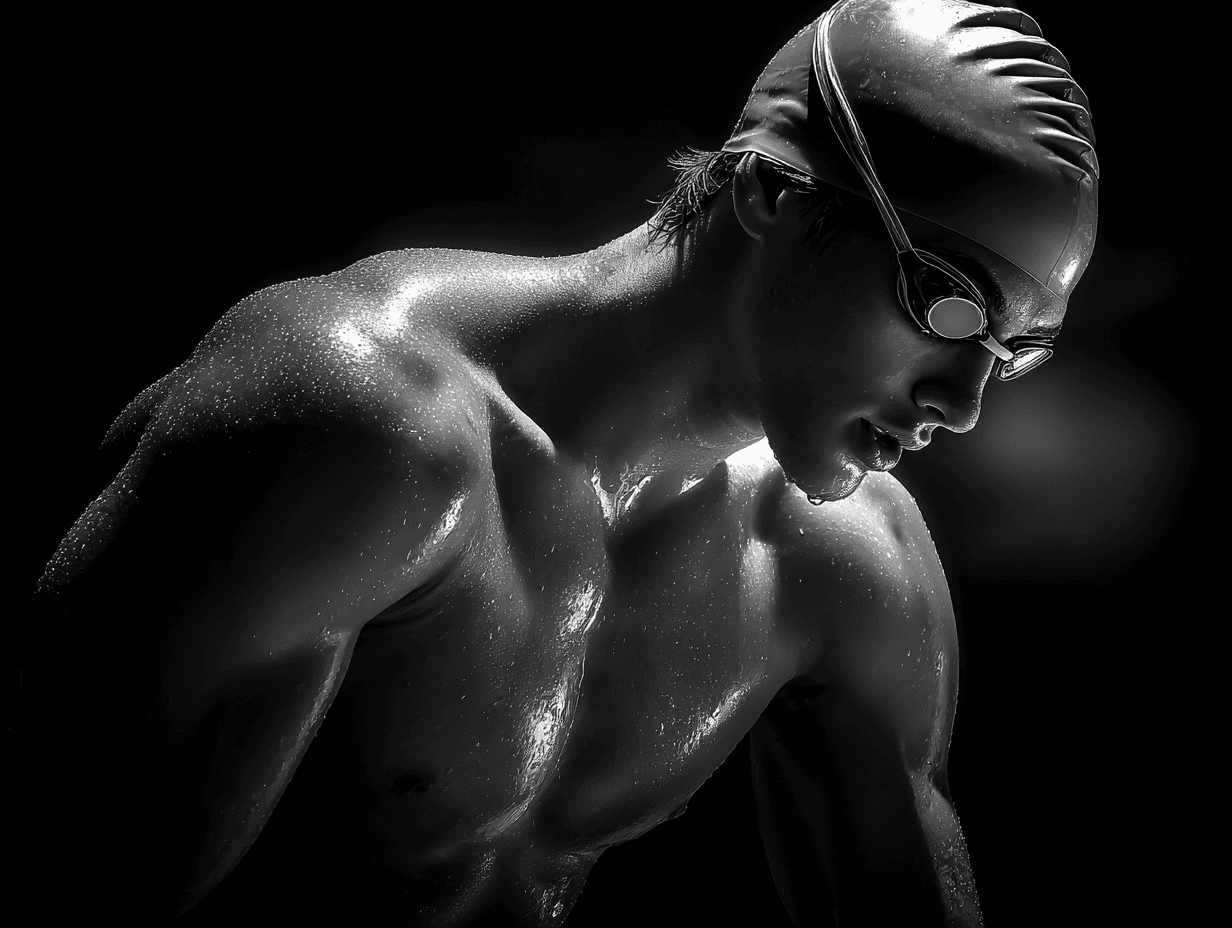
World Aquatics updated the backstroke finish rule (SW 6.3) so that once a swimmer’s head passes the 5 m mark before the wall, they’re allowed to fully submerge—which means they can potentially dolphin kick underwater into the finish instead of staying on the surface for a “classic” touch. Frontiers
Performance lives in the last 5 meters
Papadimitriou and colleagues took that “what if” and treated it like a performance problem, not a debate. They analyzed an Olympic-level, 19-year-old backstroker performing three all-out 20 m backstroke efforts using:
- Classic (some part of the body breaks the surface at the touch)
- Dive–One hand (submerge and finish with one hand)
- Dive–Streamline (submerge and finish in a streamlined position) Frontiers+1
Then they compared his finish behavior to previously published data from regional-level swimmers. What jumps out, performance-wise, is how the elite swimmer doesn’t treat the finish as “hanging on”—he treats it like a speed transition:
- The elite swimmer’s intermediate 10 m speed was faster than the regional group (reported in the paper’s abstract as 1.68 m·s⁻¹ vs 1.29 m·s⁻¹). Frontiers
- The elite swimmer increased speed from the intermediate section into the last 5 m, while the regional swimmers tended to decelerate at that same transition point. Frontiers+1
- Interestingly, for this swimmer, Classic was still the fastest option in the last 5 m (Classic last-5 m speed was reported as 1.7% and 5.1% faster than Dive–One hand and Dive–Streamline). Frontiers
- Yet the underwater variants showed eye-catching “burst” potential: the paper reports sink-to-finish speeds of about 2.16–2.28 m·s⁻¹ for the two dive finishes. Frontiers
That’s the hook: the rule change doesn’t hand you free speed. It gives you a new design space—and the athlete’s job becomes choosing (and training) the finish that best matches their underwater engine, timing, and control.
Nuance research forces you to respect
If you’re exploring this topic seriously, the win isn’t “copy the elite finish.” The win is building a smarter understanding of when underwater finishing helps, why, and for whom. Here are four benefits grounded in peer-reviewed research—some supportive, some cautionary.
Underwater can reduce drag—so the finish becomes a hydrodynamics decision, not a habit
Supported by research. The Frontiers paper frames dolphin kicks as part of underwater swimming’s advantage: going underwater reduces wave drag and can improve efficiency. Frontiers
A systematic review on undulatory underwater swimming (UUS) notes that drag can be meaningfully lower underwater, citing evidence of about 15–18% reduction in total drag at roughly 0.4 m depth (at speeds above ~1.9 m·s⁻¹). PMC
Why that matters for the finish: The new rule doesn’t just change legality—it changes your option set. You can now choose to trade surface constraints for underwater conditions—if your underwater mechanics are actually faster.
Dolphin-kick speed is not magic—it’s built from trainable determinants (and measurable cues)
Supported by research. The UUS systematic review highlights that several variables correlate strongly with underwater velocity, especially kick frequency, kick amplitude, vertical toe velocity, knee angular velocity, and related metrics. PMC
Separately, biomechanical work on underwater dolphin kick reports a strong relationship between kick symmetry and UDK performance, with the upkick phase (not just the downkick) showing important relationships to speed. ScienceDirect
Why that matters for the finish: If you’re going to “cash in” dolphin kicks at the wall, your finish isn’t a wall-touch trick. It’s a reflection of your underwater engine—and engines can be tuned.
The finish can be reframed as “speed management,” not “last-second effort”
Supported by research, with real-world race relevance. In this case report, the elite swimmer increased speed from the intermediate 10 m into the last 5 m, and the dive variants produced very high sink-to-finish speeds—suggesting there’s real upside when underwater skill is high and the transition is clean. Frontiers+1
Race-analysis research also frames finishing performance as tied to the ability to maintain or increase speed into the last 5 m. PMC
Why that matters for the finish: You can train the finish like you’d train any other performance transition: entry timing, velocity preservation, and the smallest possible “leak” of speed before contact.
The contradiction that makes you better: the finish often matters less than starts/turns—so you must earn the right to focus on it
Contradicted (or at least constrained) by research—usefully. The Frontiers paper itself acknowledges that prior work has argued starts/turns (and stroke/turn technique) can have a greater influence on race outcomes than the finish. Frontiers
Marinho and colleagues’ analysis of elite races found stronger “race effects” in start and turn variables, while finish effects were more limited depending on stroke and sex category. PMC
Why that matters for the finish: This contradiction is a feature, not a bug. It pushes you into a high-performance mindset:
- Don’t over-invest in finish mechanics if your start/turn speed is leaking seconds.
- But if you’re already “elite-clean” elsewhere, the finish becomes a plausible place to find hundredths—and hundredths decide lanes, finals, medals.
Also worth stating plainly: the Frontiers article is a single-athlete case report, and the authors note results cannot be generalized without more elite swimmers. Frontiers
Make the rule change yours
This topic basically demands personalization because underwater performance is highly individual. The UUS review explicitly notes that an athlete’s optimal movement combination may differ from others due to individual constraints and how they generate propulsion while minimizing drag. PMC
If you want more engagement (and better decisions), use conversational AI like a thinking partner—not an oracle. Here are four copy/paste prompts designed to turn curiosity into action:
- Experiment Designer: You are my swim performance scientist. Help me design a 2-week micro-experiment to compare three backstroke finish styles: Classic, Dive–One hand, and Dive–Streamline. Ask me 10 questions first (event distance, skill level, pool setup, fatigue, breathing pattern, etc.). Then give me: (1) a testing protocol, (2) 3 metrics I can measure with just a phone video, (3) a simple scoring rubric, and (4) how to interpret results without fooling myself.
- Video + Cues Coach: Act as my underwater dolphin-kick technique coach. Based on my description of what I feel and what I see on video, give me 5 likely technique issues and 5 drill progressions. Focus on: kick symmetry, upkick quality, body wave timing, and staying at a useful depth without losing speed. End with 3 “one-sentence cues” I can repeat before each rep.
- ROI Decision Helper: Help me decide whether focusing on backstroke finish technique is worth it right now. I will paste my last 3 race splits (or practice timed 25s/50s), plus notes about my start and turn quality. Create a priority list of the top 5 things to improve next, explain why, and tell me exactly what evidence would make you move “finish work” higher or lower on the list.
- Art + Data Motivation Builder: Turn my swim training into a creative system so I stay consistent. Design a weekly routine where I capture 2 underwater clips, extract one simple metric (kick count, kick rate, or time from 5m-to-wall), and transform it into something visual (a mini poster, a simple chart, or a “progress gallery”). Make it feel like a design project—not homework—and keep it sustainable in under 20 minutes/week.
Customizable purpose to innovation
Here are specific, repeatable ways to make this research usable without turning your life into a lab.
Build a “Finish Lab” that’s tiny, consistent, and scientifically honest
Twice per week, 12 minutes total (yes, set a timer):
- After warm-up, do 3 rounds of:
1 × 20 m all-out with Classic finish
1 × 20 m all-out with Dive–One hand
1 × 20 m all-out with Dive–Streamline - Film from the side with your phone (same spot every time).
- Track just one metric for two weeks (e.g., time from the 5 m mark to touch, or kick count + time).
This is science (controlled comparison) + design (low friction habit) + technology (phone video). And because the Frontiers study suggests performance hinges on transition speed and dolphin-kick capability, your “finish lab” is really a weekly check-in with how well you’re converting skill into speed. Frontiers+1
Create a “Kick Signature” artifact so training feeds identity (not just fatigue)
Once a week, turn a single data point into something you want to look at:
- Pick one: kick rate, kick count, or 5 m-to-wall time.
- Make a simple visual: a minimalist note card, a phone wallpaper, a one-line “trend strip,” or even a generative-art screenshot based on that number.
- Put it somewhere visible (locker screen, phone home screen, training journal).
That’s art (expression) + science (measurement) + design (environment shaping behavior). The goal is a sustainable loop: you don’t just do training—you see yourself improving, which keeps you coming back.
Protect the engine with “undulation hygiene” (so your finish work doesn’t steal from tomorrow)
If you’re adding underwater work, pair it with a 6–8 minute daily mobility/strength micro-routine:
- 90 seconds thoracic extension / rib mobility
- 90 seconds hip flexor length + glute activation
- 90 seconds ankle plantarflexion capacity
- 90 seconds trunk control (hollow hold or dead bug variations)
This is the “industrial design” of your body: small maintenance, done often, so your performance upgrades don’t create durability problems.